

The Solution Becomes an Agent
Artificial Intelligence · Architecture · Agentic Business Solutions
A Thesis on the Architecture of Future Business Solutions
Most companies use agentic AI today to produce the same kind of software faster. That brings speed. The larger change comes when agentic AI becomes part of the solution itself – because then the reason for a whole class of applications disappears.
Calendar and contacts are the simplest example. Nobody wants to enter data there. I say that there is an appointment, that a mail is to be written, that a contact needs to be completed – and it happens. If I ask what is due on Thursday, it is shown. What remains of the application is the data model.
This article describes what we expect the architecture of such solutions to look like. It is a thesis, derived from our work on business-critical systems and on agentic solutions – and it is meant to be discussed.
The Model Is the Workplace
At a workplace today, three kinds of people stand around an application. The customer brings the case – directly through portal, app or interface, or by call centre, letter and telephone. That second route also carries everything the application cannot handle itself. The specialist takes the case, understands it with judgement and experience, and works it through the screens of the application: masks, mandatory fields, fixed order.
The third is application development. When the application is not sufficient, the specialist cannot improve the tool. A requirement is written, a project set up, a release planned and accepted – months, often years. This is why every business unit knows the unofficial world of self-built spreadsheets: it is the answer to a path that is too long.
The architecture described here does not automate a process. It automates this workplace. The customer and the two routes remain. The specialist remains as a supervisor who initiates and oversees instead of carrying every case through screens. And the long path through a development project is no longer needed for each extension: the solution extends itself during operation, within guardrails that people set. Engineering moves to where it has the most effect – architecture, data model, guardrails and quality gates.
Three Parts Remain – and a Creative Core
The interaction environment has two halves. One is the generic entrance: orders and questions in text, voice or image, and the answer to them. The user leads, in their own order and with fuzzy input. The other half consists of predefined views – policy view, report, list – that always show the answer to a recurring question in the same familiar and efficient way.
The living data model defines the structure of the relevant information and grows with the business. It is the most stable and at the same time the most valuable part of the solution.
The deterministic building blocks are predefined views, calculation rules, data access and mass processing. They are inexpensive, fast, auditable and repeatable. What is new is where they come from: the creative part produces and maintains them as soon as a task recurs.
The creative core consists of a language model that understands, formulates and reasons, and an agent that takes on orders and uses the model for them. Core and building blocks do not stand on top of each other but side by side, on the same data model. Where a building block fits, the core calls it; where none fits, it works directly. The building blocks are an offer of efficiency, repeatability and proof – not a wall.
Such a solution is no longer an application that waits for the next intended call. It is an agent for a subject area – policy, claims, billing – that takes on requests, analyses the case, finds out what is missing, works out a way to the solution and carries it out. A service delivers what was intended; an agent delivers what follows from the case.
The Choice Is Itself Deterministic
Who decides which of the two pillars handles a case? If that were left to the judgement of the core, reproducibility would be lost: two similar cases could take different paths, and nobody could explain why.
The choice is therefore an entry in a register. For each task the register states which building block handles it, in which version, with which approval class and since when. The core looks the task up and calls what is entered – same task, same entry, same building block, whatever the wording of the case and whichever model is at work. The core works freely only where no entry fits. Exactly this case is logged, because it is the candidate for a new building block.
Extension at Any Time Instead of a Release Cycle
Agents already write small programs while they work – an evaluation, a conversion, a reconciliation – and discard them afterwards. Future solutions turn this into a principle: functionality is added during operation. So that this stays manageable, each building block gains commitment step by step.
- 1 · Ad hoc. The agent writes code for a single case and discards it. Nothing remains, but every execution is logged.
- 2 · In the register. If the task recurs, the one-off code becomes a building block with a register entry, tests and a version. For views and evaluations without external effect, that is sufficient.
- 3 · Approved by the business. If the building block touches money, a deadline or a commitment, a supervisor approves it. That takes hours instead of months – and it remains a human decision.
- 4 · Shared. Proven building blocks become available to other agents and subject areas.
Three things make this cycle convincing. A person decides the business intent, because building blocks produced quickly also implement a wrong requirement quickly. The verification grows along with them: test cases, historical data, approval by class. And building blocks are observed and confirmed again, so that an outdated rule is noticed early.
Typed, Local, Cut Vertically
If the creative core writes and maintains the building blocks, a question arises that nobody had to ask before: for whom is the code cut? The prevailing ways of building of the last thirty years – layers, frameworks, deep inheritance, configuration elsewhere – were designed for people. They avoid repetition so that nobody forgets to change a copy.
For a machine this turns around. To carry out one business change safely, an agent has to know the interface, the service, the business objects with their inheritance, the data access and the configuration. The context is large and scattered, and errors arise where one place is overlooked. A vertical cut is better suited: one self-contained building block per business transaction, from input to data storage. It accepts more duplication – deliberately, because the register knows which building blocks implement the same rule. A strict type check stays valuable, because every change is checked immediately.
An Example: myInsure
myInsure shows what this architecture feels like. It is our demonstrator of a policy administration system for private property insurance in Germany and Austria. It covers customers, products and tariffs, applications, versioned contracts, collections, claims and intermediaries, plus a customer portal. All customer and contract data is synthetic. The application itself is German; for this article its screens are shown in English.
Back Office: the Request on the Left, the Result on the Right
The application has two halves. On the left, staff phrase questions and requests in their own words. On the right are result forms that only display: overviews, files and tables, clickable down to the detail, without a single input field. With every message the agent knows what is currently shown on the right, and it opens the fitting view itself.
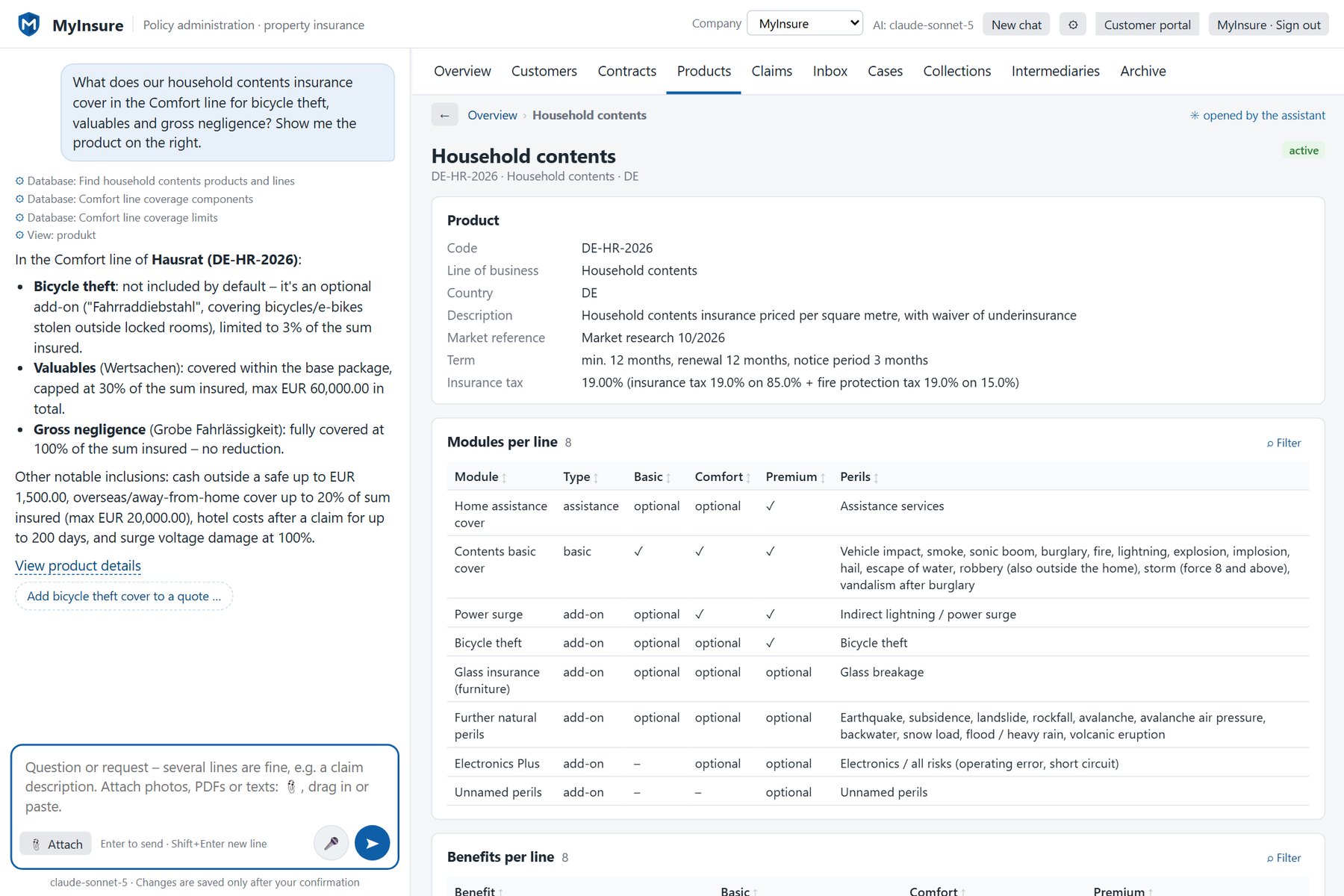
In the picture, the clerk asks what the household contents product covers in the Comfort line for bicycle theft, valuables and gross negligence. The agent answers with the values from the product model – bicycle theft as an optional module up to 3% of the sum insured, valuables up to 30%, gross negligence fully included – and offers the obvious next steps as buttons.
Changes: Preview First, Then Confirmation
Requests that change data run in two stages. A claim report in one sentence – “Hannah Fisher’s dishwasher leaked yesterday, the parquet floor in the kitchen is swollen” – is enough to start. The agent finds the customer and the contract, loads the rule set for this peril, takes over everything the description provides and asks only for what is missing.
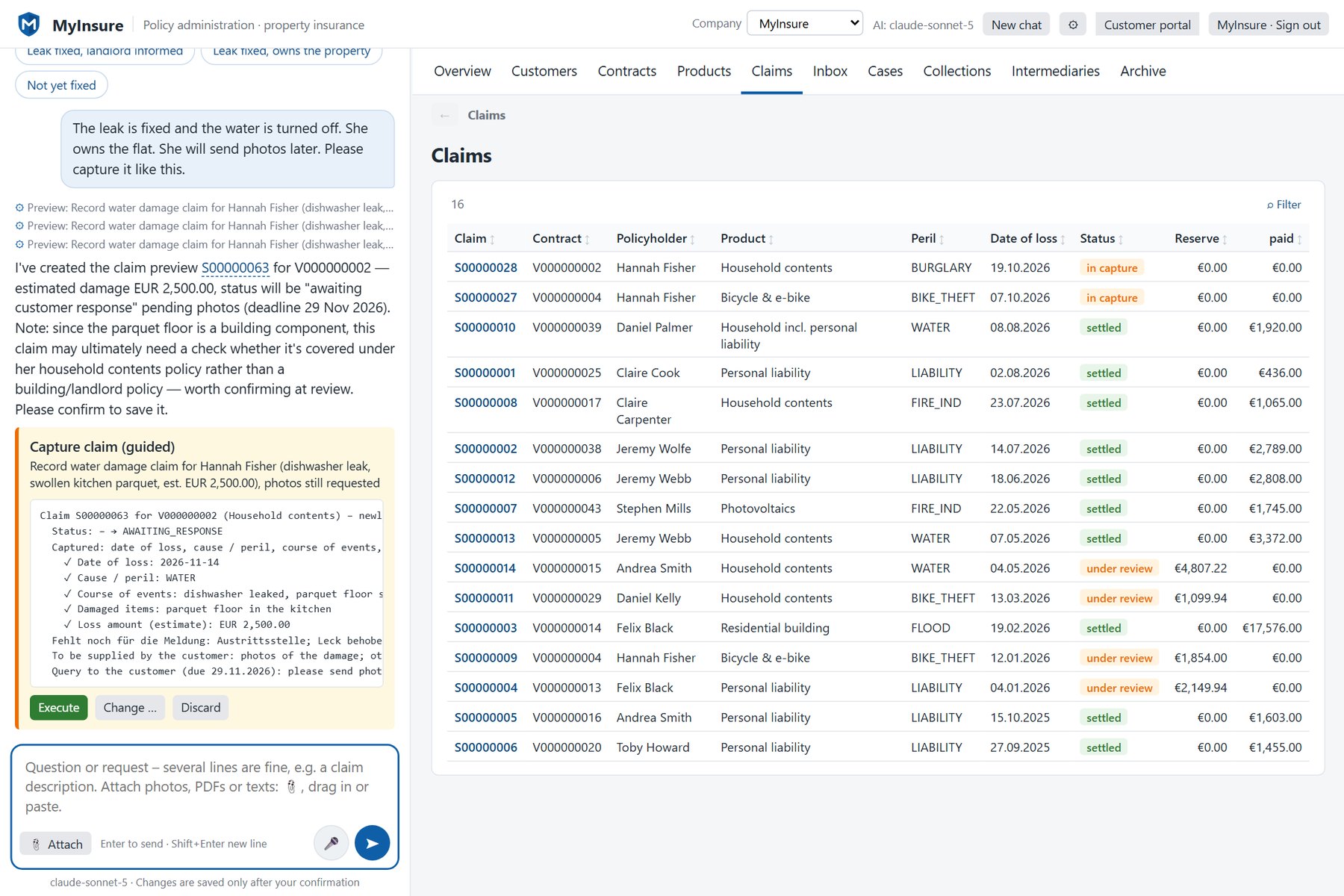
The application then executes the transaction on trial and rolls it back. The dialogue shows the preview: claim number, status, cover, captured details and what the customer still has to supply. The domain logic adds two notes of its own – an overdue premium that has already been dunned, and the question whether a parquet floor damaged in an owner-occupied flat belongs to the buildings insurance. Data is saved only when a person clicks “Execute”.
The split matches the parts described above. Cover check, rating, versioning and dunning are deterministic domain modules. The agent calculates no premium and decides no cover; it selects the right module and supplies it with data. Reading uses a read-only connection, and tenant separation sits in the data layer, below the agent.
Customer Portal: the Same Domain Logic, a Different Entry
The customer portal uses the same data and modules. Customers see their contracts, payments, claims and mail, and an assistant of their own knows exactly their file – and nothing more.
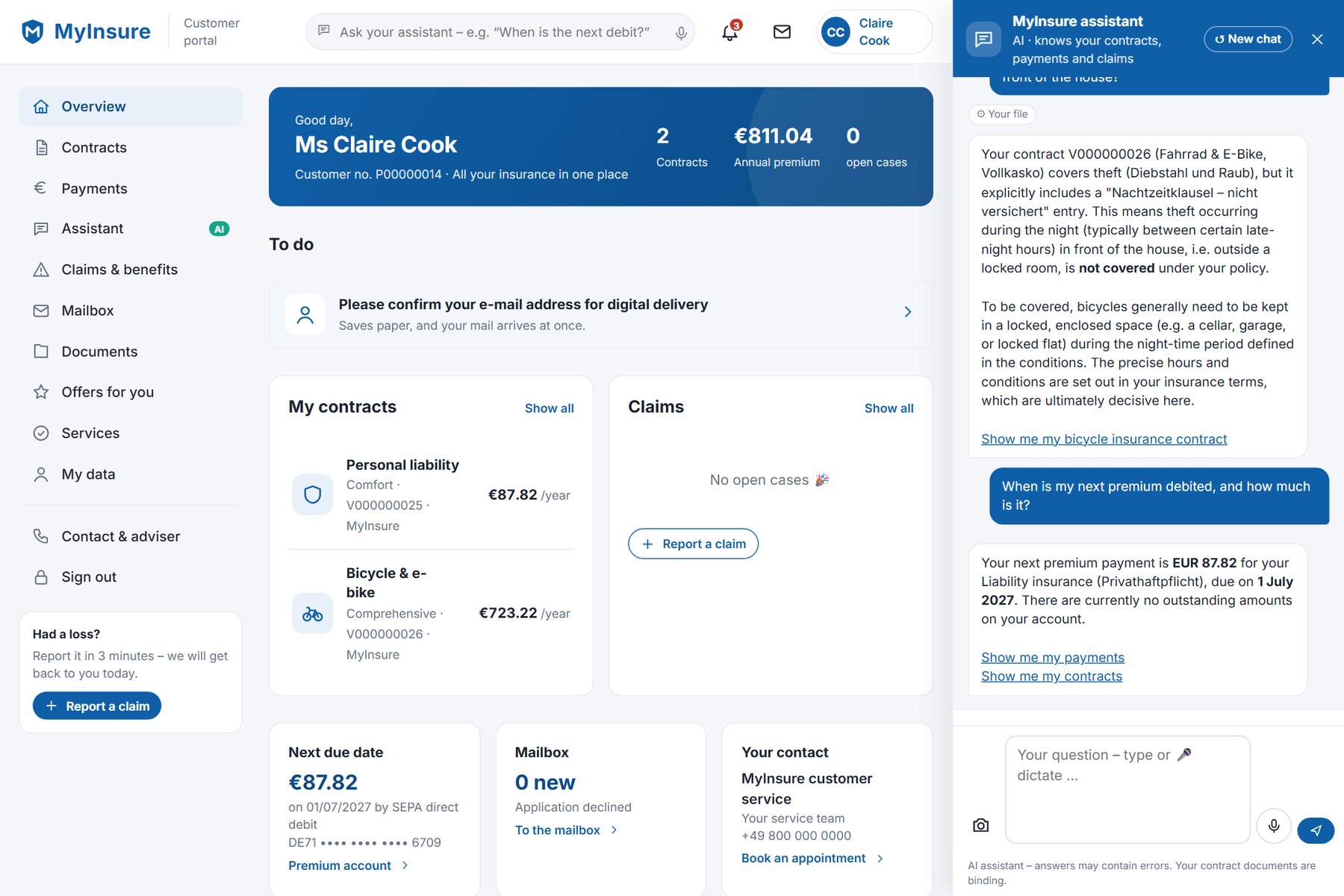
Asked whether the bicycle is also insured when stolen at night in front of the house, it answers with the clause from the specific contract and links the policy document. It names the next direct debit with amount and date. It also takes a claim report in dialogue, which arrives in the back-office inbox.
The Products Were Sourced by Agents, Too
It is worth noting where the domain knowledge comes from. The products in myInsure – household contents, residential buildings, personal liability, bicycle, photovoltaics and more, with their lines, modules, limits and premium rates – were not modelled by hand. Agents researched them from public sources: policy conditions, benefit overviews and published sample premiums, plus tax rules from the legal texts and an open postcode directory.
The same discipline applies as in operation. Every source is recorded with its date, and whatever is not published sits in the model as a marked assumption. The premium rates are cross-checked against public examples: for a household policy with 90 m² the model yields €245.95 against a published premium of €246.40. Research thus becomes a verifiable product model on which application, rating and claims handling work deterministically.
The Next Step: Industry Models
The picture with two pillars is not the last stage. We consider it very likely that capable industry-specific models and agents will soon come onto the market – just as specialised AI already exists for image, video and music. An insurance model for a national market will be able to do what conventional applications do today: set up a policy, change it, give information, check a claim.
The AI part then becomes dominant. What remains of the deterministic part changes its role: it no longer calculates itself, it checks what the model proposes. The data model stays, because the state of every policy has to be recorded somewhere. Traceability changes as well: if a million very different cases have run correctly in the test, that is a different kind of proof from a program one can read – but a strong one. Supervision will follow this development rather than lead it.
Where the boundary between conventional software and AI runs is therefore not decided once. It is managed – task by task, according to the cost of an error, volume, response time and verifiability. The register is the place where this happens.
Where to Start
The way there does not begin with replacing what exists. It begins with the special cases: the cases your current systems were not built for and therefore hand over to people. They bind the most working time and cause the longest processing times. Agentic use does not require a system to be replaced; in most cases a second access next to the user interface is enough.
Two questions help with the first step. Which special cases, sorted by frequency times processing time, are worth it? And how accessible are your systems for agents today? We answer the first together with your business units in an AI Business Solution, the second in an Application Assessment.