

Swiss Life: The Life Insurance Policy System, Renewed in Running Operation

More than 1.2 million policies, contract terms spanning 176 years and a system grown over almost 30 years: after two years, 80 percent of the functionality is in production on the new platform – in time and in budget.

01Success story
Client
Swiss Life Germany
Industry
Insurance
Solution
Policy administration for individual life insurance: from ILF (Individual Life Factory) to CIP (Core Insurance Platform)
Period
2023–2026
Our role
Development partner, with a binding price for each functional increment
Technologies
C, Oracle PL/SQL, terminal screens → Java, web interface, services, cloud-ready architecture
Presented
Presented jointly by Swiss Life and itestra at the Legacy IT conference of IT-Woche 2025, Versicherungsforen Leipzig, 7 May 2025
80 %
of the functionality in production after two years
1.2 M+
policies in the system
176
years spanned by the contract terms, from 1933 to 2109
1.5 M
lines of code in the previous system
02Starting Point

Starting Point

Swiss Life is one of Germany’s leading providers of pension products and financial advice. Its policy administration for life insurance holds more than 1.2 million policies; once a policy is in the system, it stays there – the earliest began in 1933, the latest ends in 2109.

The system had been developed over almost 30 years: around 1.5 million lines of code, a monolith with many interfaces to neighbouring systems and terminal screens. Workarounds with surrounding systems had made processing a slalom between systems, many tests were manual, few people knew the technology well, and new staff were hard to find.

Swiss Life weighed three options. Minimal investment would have meant a creeping loss of the ability to innovate. A new purchase would have required at least three times the investment. Modernisation was set as plan A – in running operation, with product updates continuing and no frozen zone.
03What We Did

What We Did

Swiss Life started with a request for information, an analysis of the eight hotspots with the highest potential for improvement and a proof of concept – and chose itestra as its partner. Our analysis showed that the system is considerably smaller net than it looks: 0.6 million lines of code without redundancy. That made a bigger step feasible than the refactoring originally planned: a technical redesign with a consistent change of technology, at a lower total effort than refactoring with its follow-up activities.

The business logic is extracted from the code by reverse engineering and transformed by experts, increment by increment, in vertical cuts: one team is responsible for analysis, design and implementation of a functional scope. The user interface was renewed with restraint – structure and processes stay familiar, the details became considerably more comfortable.

Everything is planned and agreed precisely: a binding price for each functional increment, defined artefacts, dates and a model of cooperation, and tracking of progress and result quality by key figures. A large-scale automated comparison of old and new secures correct results. Swiss Life’s business units are closely involved, from user interface and testing to training before each go-live.

The Same Transaction, Before and After

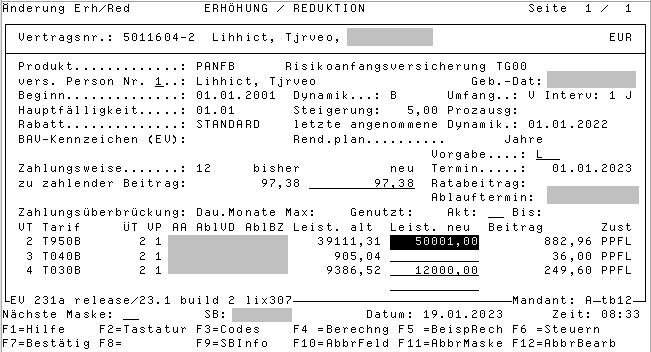
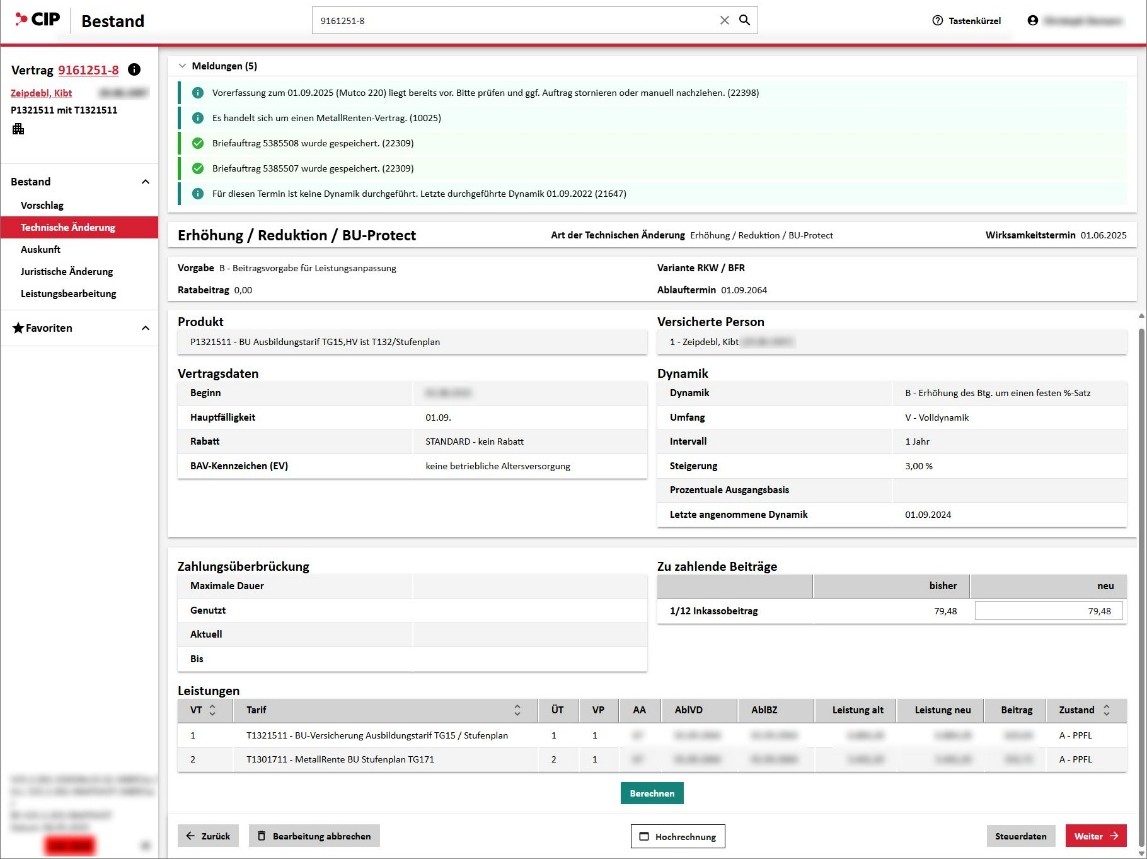
An increase or reduction of benefits in the previous terminal screen and in the new web interface. Familiar structure, clear guidance – acceptance among the users is very high.

Before: terminal screen of the previous system
After: the new web interface of the Core Insurance Platform

Result as of May 2025

  1. 01

    80 percent in production

    Information, application, policy changes, benefits and further areas run on the new platform; the remaining scope follows by 2026.

  2. 02

    In time and in budget

    With a binding price for each functional increment.

  3. 03

    Hotspots removed

    All identified hotspots are gone – and the platform is ready for the cloud and for innovation.

  4. 04

    No frozen zone

    Business requirements were implemented continuously during the modernisation.

  5. 05

    Correct results, target performance

    Secured by large-scale automated regression tests; the performance target is met.

  6. 06

    Very positive feedback

    From the business units that work with the new interface every day.

World-class computer science for tomorrow's digital business